AI Still Has to Plug In Somewhere
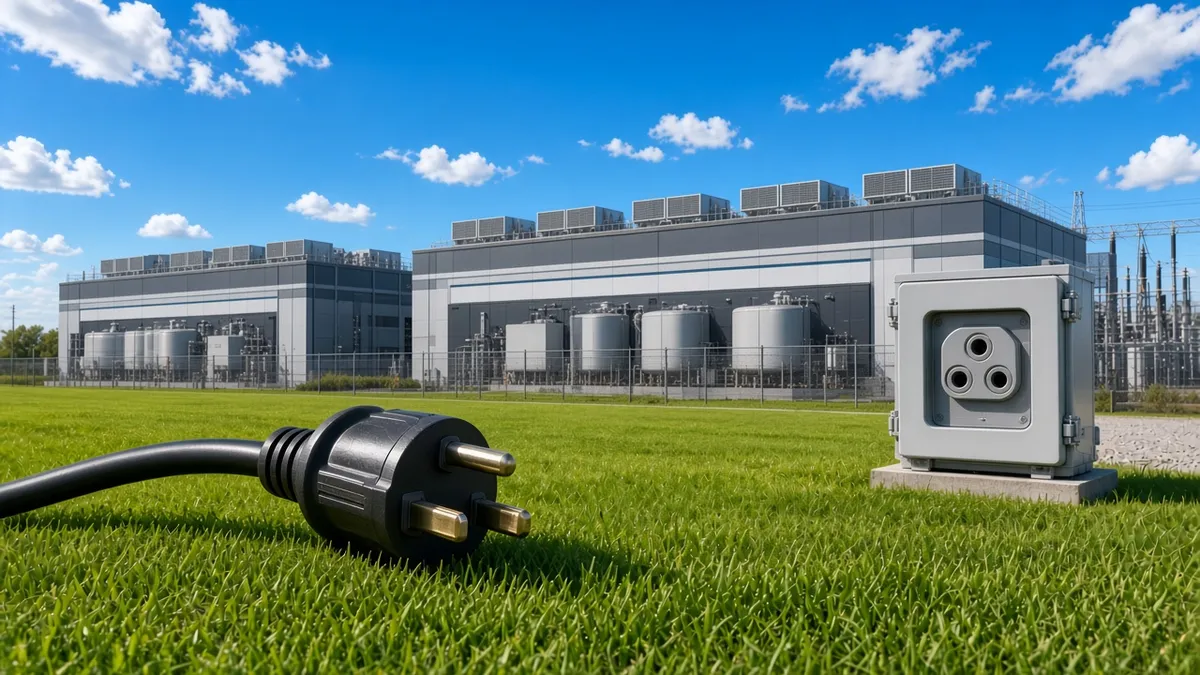
Wood Mackenzie puts the wait for a data center grid connection in Ohio at 84 months. A company that decided this month to build there would not get power from the grid until late 2033. In Virginia, which the firm calls a hot spot for data centers, the best case is 54 months. The building, the servers, and the business plan for that site all wait on the same hookup.
Jensen Huang has made this point all fall. On Nvidia's August earnings call, he said companies can no longer simply buy the technology and stand it up, because they first have to secure the land, the power, and the building shell, which is often a couple of years away. On the BG2 podcast in October, he called the move from digital to physical the hard part and named land permitting, new power generation, construction workers, and moratoriums. A week later in Berlin, he told Yahoo Finance that power is "one of the major bottlenecks." He added that even when power is available, a site can be held up by construction, by a generator that has not been delivered, or by the connection to the grid.
In that same interview, Huang said the limits keep moving. They started with wafer capacity and then moved to chip packaging, memory, silicon photonics, and even connectors, and he expects them to last probably a couple more years. He did not say chips and memory stopped being a problem. His point was that power, land, buildings, and construction have joined them. After years when most of the attention went to models and software, the physical world is again setting the pace for AI.
The equipment waits show why. Wood Mackenzie puts the wait for large gas turbines at 278 weeks, for transformers at 162 weeks, and for circuit breakers at 137 weeks. The firm counts 400 moratoriums called by lawmakers on data center proposals, and one fifth of projects under development have been delayed by one. Utilities have committed to connect 201 gigawatts of new data center capacity, but Wood Mackenzie sees no realistic way to add supply at any scale in 2027 or 2028 beyond those commitments.
The same pattern shows up inside the equipment. On November 18, the Global Electronics Association issued an alert on circuit board shortages. A typical personal computer board has about 12 layers, while AI server boards are moving to 40 to 60 layers or more. Every added layer uses more glass fabric, resin, copper foil, and laminate. Bookings for boards rose 56.1% in the year to September, while shipments rose only 13.3%, and boards with many layers now take 16 to 20 weeks or more to arrive. Billions have gone into new board plants in Asia, but the Association says those plants still depend on the same scarce materials, so more plants alone cannot end the shortage. It expects meaningful relief no sooner than mid 2028.
The Association says availability, not price, is the real risk, because the biggest AI buyers are locking up supply and makers of cars and of industrial, medical, and defense equipment are falling to the back of the line. That is why I don't see this as only a data center story. A smart plant needs power, a building, and circuit boards just like an AI factory does. You cannot get past a power shortage, a slow permit, a construction backlog, or a missing material with better software. Both kinds of projects depend on the same physical chain.
AI does help, and it helps most once a company knows which step is holding it back. Design tools can explore more options and check earlier whether a part can be made, and monitoring tools can flag equipment trouble before a breakdown. The University of Sheffield's Advanced Manufacturing Research Centre has shown a digital twin of a machine tool adjusting cutting operations in real time. Tools like these can help a team get more out of a limited machine or power supply, or plan how to expand it.
The full loop is not there yet. A 2026 review of digital twins built around quality found only 16 studies that met its standard for twins that carry information both ways, and most of them covered a single process. Another 2026 paper warns that a design proposed by a language model can look correct and still be impossible to build unless it is checked against the real system, and that these models still struggle with units and tolerances. Results from the floor and from quality checks do not yet flow back into design on their own, so people still have to close that loop themselves.
This matters to anyone building a budget or a capital plan. A plan can fund the servers or the new production line on schedule, while the real start date is set by the power hookup, the transformer, the permit, or the board material. If the equipment arrives first, the cash is spent while the asset waits and the forecast revenue slips. Before approving the spending, finance should ask which item has the longest wait and who confirmed that date with the utility or supplier. It should also check whether the forecast still assumes last year's lead times. The plan that holds up is the one built around the slowest piece of the physical chain, with the money timed to match it.
Originally published on LinkedIn.