Elon Wants More Frickin’ Space Lasers
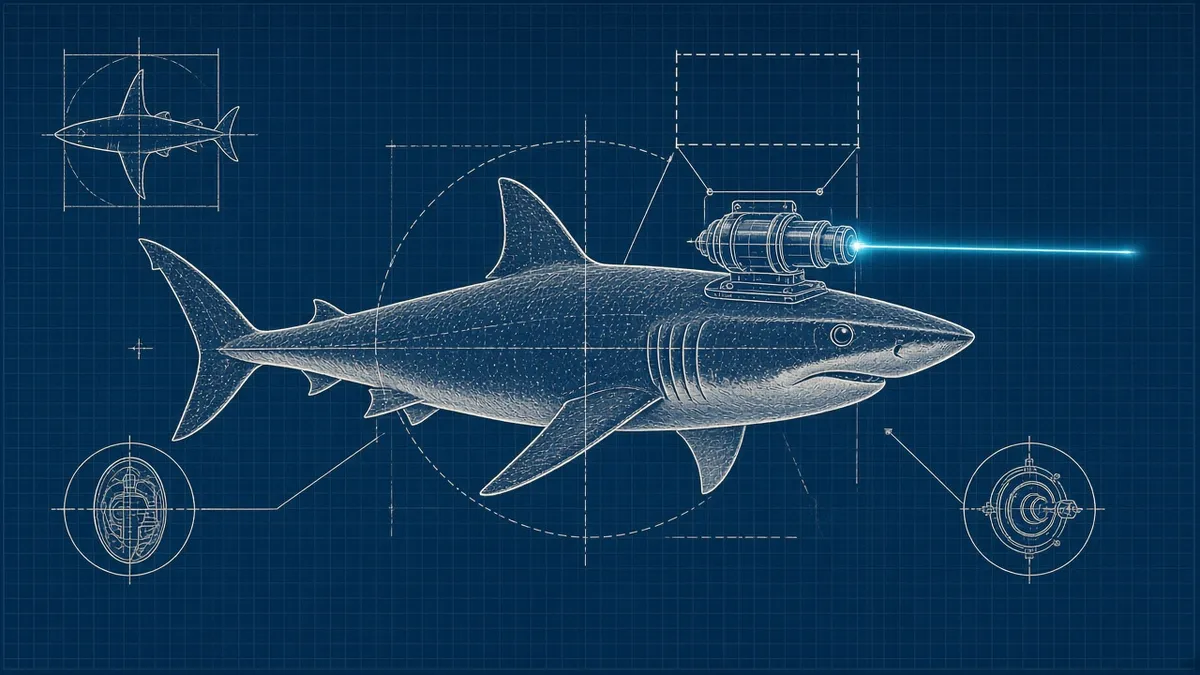
Dr. Evil wanted sharks with frickin’ laser beams on their heads and ended up with ill tempered, mutated sea bass. Unlike Dr. Evil, SpaceX can deliver. Its satellites already pass data through space using lasers. Now Elon wants a lot more of them.
On November 6, Musk wrote that about 100 lasers per satellite, each operating above 10 terabits per second, across more than 100,000 satellites should be able to outcompete undersea cables. These are communications lasers, not weapons. A Starlink dish sends data by radio to a satellite, and narrow laser beams can pass that data between satellites. It comes back down by radio to a ground station connected to the internet, letting traffic cross an ocean without a ground station near the customer. It does not eliminate ground connections.
Starlink already operates this kind of network. Its 2025 progress report says that during the April 2025 power outage in Spain and Portugal, its satellites used laser links to send traffic to working ground stations elsewhere in Europe. The report also describes routing around undersea cable failures. The newer V3 design has six lasers rated at 400 gigabits per second each, and SpaceX put 26 V3 satellites in orbit in September. Musk’s proposal goes far beyond that, and his numbers describe links between satellites, not the speed of a home connection.
Laser signals travel faster through space than through fiber optic cables. Some routes in orbit can also be shorter than the path a cable has to follow along the sea floor. More lasers could carry more traffic, cut delay on some long routes and give customers another path when a cable fails.
Getting to 100 lasers on one satellite is not as simple as bolting more on. Each laser needs room, and each one has to stay aimed at another moving satellite. In a follow up post, Musk suggested smaller lasers, satellites much closer together and connections within the same orbital plane that would require less steering movement. He wants more connections, so he is looking at what keeps them from fitting and working. The size of the lasers and the spacing between satellites are things his team can change, not conditions they have to accept.
That connects directly to the Theory of Constraints, developed by Eli Goldratt. Find what limits how much the operation can deliver, then work on that limit. Adding capacity somewhere else will not increase output if the work still gets held up at the same place. Sometimes the answer is more equipment at the constraint. Sometimes changing how the work gets done can free capacity before we buy anything.
Suppose a distribution company’s loading and unloading capacity limits how many deliveries it can complete each day. It already owns enough trucks to carry everything its docks can handle. Buying more trucks does not increase deliveries because the company cannot load or unload them any faster. It now has more money tied up in vehicles, along with insurance and maintenance costs, but the same output. Increasing the docks’ loading and unloading capacity could let the trucks it already owns complete more deliveries.
That is the distinction finance needs to make before approving a capital investment. What is preventing us from delivering more today? Does the proposed purchase change that, and do customers want the additional output? If another dock bay is the answer, the investment also needs the staff and equipment to operate it. An empty bay does not move another truck.
Companies that make better capital decisions win. While one company buys more trucks and adds cost, another improves loading and completes more deliveries with its existing fleet. What I appreciate about Musk’s approach is his willingness to work through what limits the result and change the equipment or its arrangement to overcome it. Finance teams can bring that same thinking to capital decisions, putting money where it increases what the business can deliver rather than simply increasing what it owns.
Originally published on LinkedIn