Where to Look First When You Bring Production Home
The Wall Street Journal ran a story titled "An American Furniture Maker Tried to Bring Jobs Back Home. It Didn't Work." It follows Bruce Krinsky of TOV Furniture. He took over a struggling factory in High Point, North Carolina, and agreed to keep it running and invest in it. After 10 months and about $3 million in losses, he closed it on July 31. The WSJ article is written as a story about tariffs but misses on what manufacturers should do when one step limits what the whole plant can produce.
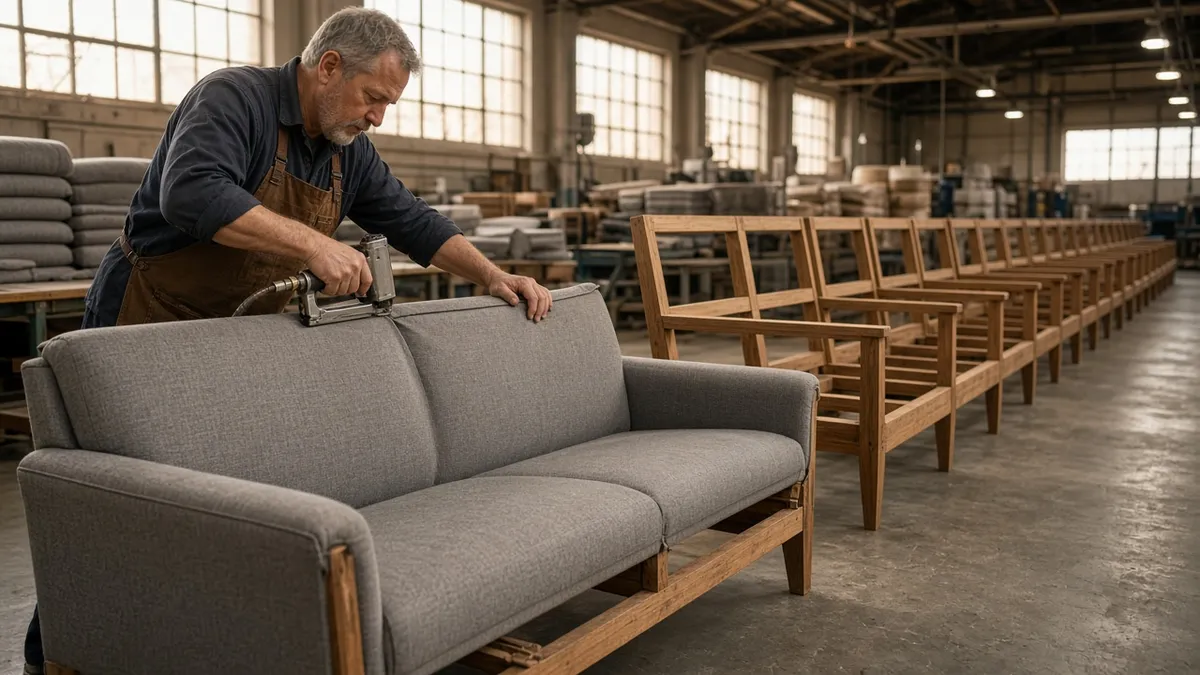
In Krinsky's plant that step was upholstery. Upholsterers were so scarce that when one missed a month, Krinsky could not replace him. His upholsterers finished two to three sofas a day, while those at his partners in Asia finished about ten. Goldratt's Theory of Constraints gives five steps for a plant in this position. The first is to identify the step that limits output, and here that step is plain to see.
The second step is to get the most out of the constraint with what you already have. That starts with going to the floor to see the work, which Toyota calls going to the gemba. The point of going to see is to understand the work first, so you find the real problem before you try to fix anything and don't waste time fixing the wrong thing. If the upholsterers were building frames, cutting fabric, or waiting on parts, that work could move to someone else so their hours go only to what needs their skill. Frames and covers should also be checked before they reach upholstery. Goldratt's point is that an hour lost at the constraint is an hour lost for the entire plant.
The third step is to run everything else at the constraint's pace. If the frame and cutting departments build as fast as they can, the extra work just piles up in front of upholstery. That pile ties up cash in wood, fabric, and labor without producing one more finished sofa. The signal for the rest of the plant should be how fast upholstery finishes, not how busy each department looks.
The fourth step is to add capacity, and only now should you spend real money. When the constraint is a scarce skill, adding capacity means rebuilding that skill. The Journal reports that furniture jobs in North Carolina fell from 91,000 in 1990 to 27,000 this year. A skill that leaves a region does not come back on its own. It has to be rebuilt on purpose. Furniture makers in Catawba County did exactly that. They spent 14 months working with Catawba Valley Community College to build a training academy where experienced craftspeople teach courses that run 8 to 11 months. In High Point itself, Guilford Technical Community College runs an upholstery course. Anyone taking on a plant like this should know where its next skilled workers will come from.
The Journal's own reporting from Vietnam shows another way to do it. About 30 of the 130 workers at TOV's partner plant there are experienced Chinese workers who handle the most complicated pieces, and local workers are gradually taking their place. The most skilled people do the hardest work and pass the skill on at the same time.
Lucas Philips faced the same problem on a smaller scale after he bought Newark Auto, a 120 year old maker of classic car interiors, in 2021. Most of the six manufacturing workers he inherited left within a couple of months. Attendance was a constant problem, so he offered a raise of about $3 an hour to anyone who showed up on time and worked full weeks for four weeks in a row. He kept the two he could not do without: the lead cutter who was the only person who knew all the patterns, and the sewer who could sew everything. They stayed about two more years while he digitized the patterns for computer controlled cutting. He said he could not have grown otherwise because of the training each new employee would have needed. Capturing what the experts know in files and machines is another way to add capacity, because each new hire has less to learn.
The fifth step is to start over. Once upholstery keeps up, something else will limit the plant, and that becomes the new place to look.
Before you bring production home, find the step that limits the plant, go see it until you understand it, and make everything else serve it. If that step depends on a scarce skill, put the time and cost of keeping experienced people and training new ones into the plan from the first day.
Originally published on LinkedIn.